Your cart is currently empty!
N-Type vs. P-Type Solar Panels: Choosing the Right Option
The solar energy market offers various technologies, with N-Type and P-Type panels being the most prevalent types of solar cells. While both types generate electricity by converting sunlight into usable energy, they have distinct properties that can significantly impact their performance, longevity, and cost-effectiveness. Understanding these differences is essential for making an informed decision about which solar panel type best suits your needs.
Key Differences Between N-Type and P-Type Solar Panels
1. Manufacturing Process
P-Type Solar Panels:
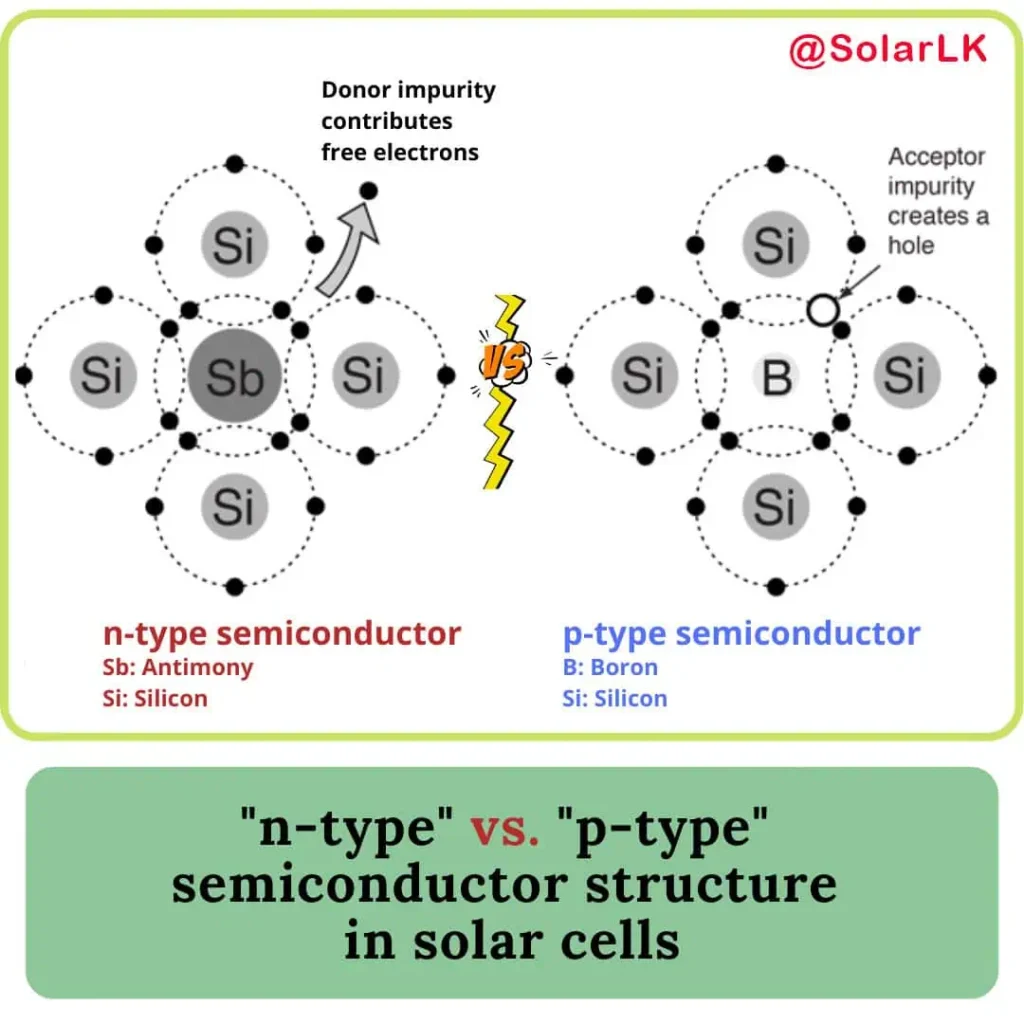
- P-Type solar panels are made using silicon doped with boron, which has fewer electrons than silicon. This doping creates “holes” in the silicon structure, allowing for positive charge carriers.
- The manufacturing process for P-Type panels is well-established and has been optimized over decades, resulting in lower production costs.
N-Type Solar Panels:
- N-Type panels use phosphorus to dope silicon, introducing extra electrons into the material. This creates a surplus of negative charge carriers, enhancing electrical conductivity.
- The production process for N-Type panels is more complex and requires advanced technology, leading to higher manufacturing costs compared to P-Type panels.
| Aspect | P-Type Solar Panels | N-Type Solar Panels |
|---|---|---|
| Doping Element | Boron | Phosphorus |
| Charge Carriers | Positive (holes) | Negative (electrons) |
| Manufacturing Complexity | Well-established, simpler process | More complex, advanced technology |
| Production Costs | Lower production costs | Higher production costs |
2. Efficiency
P-Type Efficiency:
- P-Type solar panels generally achieve efficiencies around 23.6%. While this efficiency has improved over the years, it still lags behind N-Type panels.
- The thicker base layer of P-Type cells allows for better sunlight absorption but can lead to increased recombination losses, where electrons recombine with holes before generating electricity.
N-Type Efficiency:
- N-Type panels typically boast higher efficiencies, averaging about 25.7%, primarily due to better electron mobility and reduced recombination losses.
- The thinner emitter layer of N-Type cells allows for more efficient collection of generated current, making them a preferred choice for maximizing energy output.

| Aspect | P-Type Efficiency | N-Type Efficiency |
|---|---|---|
| Typical Efficiency | Approximately 23.6% | Approximately 25.7% |
| Recombination Losses | Higher due to thicker base layer | Lower due to thinner emitter layer |
| Electron Mobility | Lower compared to N-Type | Higher due to improved material properties |
3. Temperature Performance
P-Type Temperature Sensitivity:
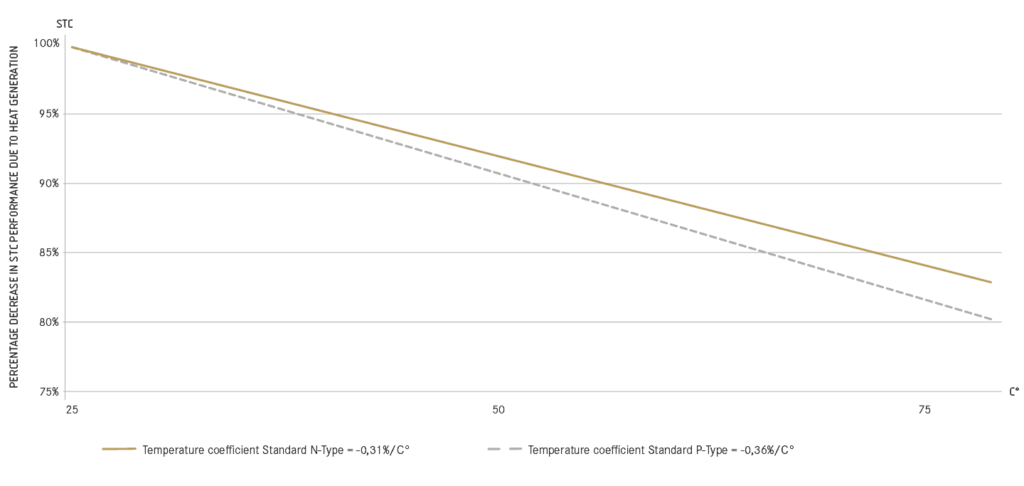
- P-Type panels experience a more significant drop in efficiency as temperatures rise. The temperature coefficient for P-Type cells is approximately -0.50%/°C, meaning their efficiency decreases with increasing heat.
- This characteristic makes P-Type panels less suitable for extremely hot climates where consistent high temperatures could negatively impact performance.
N-Type Temperature Performance:
- N-Type panels exhibit better performance in high-temperature conditions, with a lower temperature coefficient around -0.30%/°C. This means they retain higher efficiency levels even under intense sunlight and heat.
- Their superior thermal performance makes them ideal for regions that experience elevated temperatures, ensuring better energy generation throughout the day.
| Aspect | P-Type Temperature Performance | N-Type Temperature Performance |
|---|---|---|
| Temperature Coefficient | About -0.50%/°C | About -0.30%/°C |
| Performance in Heat | Decreases significantly in high temperatures | Maintains efficiency better in hot conditions |
4. Longevity
P-Type Lifespan and Degradation:
- P-Type solar panels are more susceptible to light-induced degradation (LID), which causes power loss shortly after installation due to sunlight exposure. This degradation can result in up to a 3% reduction in efficiency during the first few hours of exposure.
- They are also vulnerable to potential-induced degradation (PID), where stray currents lead to reduced performance over time. As a result, P-Type panels tend to have slightly shorter lifespans compared to their N-Type counterparts.
N-Type Lifespan and Durability:
- N-Type solar panels are designed to withstand various degradation factors better than P-Type panels. Their unique structure makes them immune to LID, allowing them to maintain efficiency over time.
- Studies suggest that N-Type panels can last longer, often exceeding 30 years of operational lifespan with minimal degradation. Their resistance to PID also contributes to their longevity.
| Aspect | P-Type Lifespan and Degradation | N-Type Lifespan and Durability |
|---|---|---|
| Light-Induced Degradation (LID) | More susceptible to LID | Immune to LID |
| Potential-Induced Degradation (PID) | More prone to PID | More resistant to PID |
| Typical Lifespan | Around 25 years | Often exceeds 30 years |
5. Cost
P-Type Cost Considerations:
- P-Type solar panels are generally more affordable due to their simpler manufacturing process and widespread availability. They represent the majority of the solar market, making them an accessible choice for many consumers.
- However, while they offer lower upfront costs, their susceptibility to degradation may lead to higher replacement or maintenance costs over time.
N-Type Cost Considerations:
- N-Type solar panels have higher initial costs due to advanced materials and complex production processes. This higher price point can be a barrier for some consumers, especially those on a tight budget.
- Despite the higher upfront investment, N-Type panels can lead to greater long-term savings through increased efficiency and lower degradation rates, making them a cost-effective option over the lifespan of the system.
| Aspect | P-Type Cost Considerations | N-Type Cost Considerations |
|---|---|---|
| Initial Cost | Generally lower | Typically higher |
| Long-term Savings | Higher replacement or maintenance costs | Lower degradation leads to long-term savings |
Environmental Impact
Both N-Type and P-Type solar panels contribute positively to environmental sustainability by generating clean energy from sunlight. However, it’s crucial to consider the manufacturing process’s sustainability as well:
- P-Type Production: The established manufacturing processes for P-Type panels have been optimized for efficiency but may not incorporate as many sustainable practices compared to newer technologies.
- N-Type Production: With advancements in technology, many manufacturers are focusing on sustainable practices in producing N-Type panels, potentially reducing their carbon footprint.
When choosing between the two types, it’s important to evaluate not only performance but also the environmental impact of the manufacturing processes used by different manufacturers.
Which Should You Choose?
Choosing between N-Type and P-Type solar panels ultimately depends on your specific needs and circumstances:
- Choose P-Type if:
- You are looking for a cost-effective solution with lower upfront investment.
- You require readily available solar panel options for standard installations.
- Your installation site is not subjected to extreme temperatures or environmental conditions that could affect panel performance.
- Choose N-Type if:
- You prioritize long-term efficiency and durability over initial costs.
- Your location experiences high temperatures or variable weather conditions that may affect performance.
- You want a system with less susceptibility to degradation over time for better long-term savings.
Conclusion
In summary, both N-Type and P-Type solar panels offer unique advantages and disadvantages that cater to different needs and preferences. Understanding these differences can empower consumers to make informed decisions that align with their energy goals and financial circumstances.
Whether you choose N-Type or P-Type solar panels, both options contribute significantly to harnessing renewable energy and reducing reliance on fossil fuels, thus playing a vital role in creating a more sustainable future.
Before making your decision, consult with your solar provider about your specific situation and preferences. They can help guide you toward the best choice for your home or business based on local conditions, energy needs, and budget considerations.